
Making a flax angel
21 December 2008Click here to visit an upgraded version of this blog post on my new website at alibrown.nz.
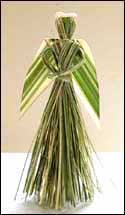 Even though there are only a few days to go before Christmas, there’s still time to make the odd flax decoration. Shredded flax lends itself to making an angel in much the same way that straw and grasses have traditionally been used to make angels in other cultures. I’ve used variegated flax for the angel design illustrated in these instructions, which is a very quick and easy design to construct.
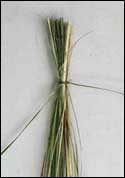 Shred two or three flax leaves with a fork or dog comb. Tie the shredded flax into a bundle with another piece of flax.
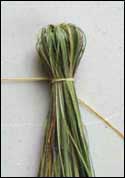 Turn the bundle up the other way so that the tie is inside the bundle and the shredded flax hangs down and around the tie, then tie another strip of flax around the bundle. This will make the neck of the angel.
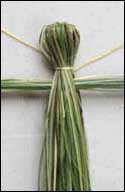 Shred a little bit more flax for the arms. Tie the shredded flax together in the middle and then slip it in between the shredded flax of the body. Push it up so that it’s right underneath the tie for the neck.
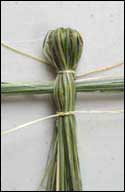 Tie another piece of flax around the body below the arms to create a waist. Now shred some more flax and divide it into two bundles.
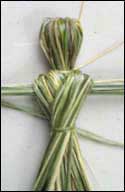 Drape one bundle over the right shoulder and bring it across the front of the body to the left. Drape the second bundle over the left shoulder and bring it across in front of the body to the right. Tie these in place around the waist.
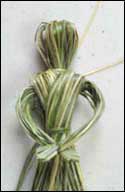 Bend the arms around to the front and tie them together in the front of the body. Cut off the ends of the flax, shaping the ends into hands.
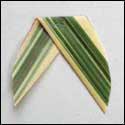 To make very simple wings, take a piece of a flax leaf and scrape a blunt knife along both sides to soften and dry it a little to prevent the wings from curling up. Fold the flax on an angle with the fold at the top and a piece of flax coming down at an angle on each side and cut these sides into wing shapes. Staple the pieces in place close to the fold. (I used variegated flax to make the wings look feathery but no doubt more elaborate wings could be made by splitting and folding the flax in other ways). Attach the wings to the angel’s shoulders at the back. I stapled the wings on but you could use superglue.
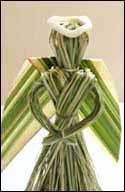 You can draw a face on the angel or use a shell for her face. I’ve left the face as it is but have given her a halo by placing a rounded, smoothed-by-the-sea piece of shell on the top of her head.
Trim the ends of her dress off evenly at the bottom and cut off any stray threads. If you want to stand the angel upright on a flat surface, spread her robe out over something like a small stone or piece of wood. This will help her to keep her balance so she doesn’t fall from grace!!
For those who are waiting for my book, Weaving Flowers from New Zealand Flax, you may be interested to know that the writing and illustrations have now been completed. I’m currently sorting out its printing on my home printer. Printing is a slow business on a home printer but it shouldn’t be too long before the book is ready for sale.
© Alison Marion Brown 2008.
December 21st, 2008 at 9:45 pm
I just wanted to say how much I have enjoyed all the information you have provided on these pages. I have been surrounded by many wonderful flax weavers, in family and friends in the Hokianga, my home, but never really got the hang of weaving.Mine always seemed to not work and I only got frustrated. After looking through your pages, I feel inspired to have another go and am grateful to you for your effort to put out the information. Thankyou, Jacqui.
December 22nd, 2008 at 7:00 am
Hi Jacqui
Thanks for your comments about the web site. I’m glad you’ve found it has inspired you to get into flax weaving again. It’s great to have lots of flax weavers around you as I’m sure they will inspire you too. Happy weaving!
December 22nd, 2008 at 1:31 pm
Kia ora Ali, this looks great - will give it a go today
Do you have simple instructions for starting a closed top potai (hat)? I can “add in” to make it bigger, just wondering the best way to start. Take care, happy holidays!
Aloha no,
Chrissen
January 4th, 2009 at 6:41 pm
Hi Crissen
I hope your flax angel went well!
I don’t have any written instructions for making a closed top for a hat. Hats can be started in different ways, and the most common way seems to be starting with a plait. You’ll find instructions for this in Mick Pendergrast’s book, Te Mahi Kete, which I mention on my Reviews page.
January 8th, 2009 at 9:10 am
Hi, could you please add me to the long list of people wanting to purchase your putiputi booklet. Thanks very much. Julz
January 12th, 2009 at 11:24 am
Hi Ali it has been a cold, wet and windy weekend here in ireland and I have just spent a most enjoyable time making your flax flowers, four way plait and I have even got my eight year old son making the bracelets - we are all addicted. Please please add me to you booklet list - thank you so much for you wonderful website.
January 12th, 2009 at 1:05 pm
Hi Julz and Orlaith
I’ve added your names to the book database.
Orlaith - it’s so nice to hear from you. We have a lovely sunny day here in Christchurch, New Zealand! I’d be interested to know where you get your flax from. Do you have it growing in your garden? Is it readily available in your area?
January 13th, 2009 at 2:54 am
hi Ali
A lot of New Zealand plants grow well here and are very popular. Phormium tenax is probably one of the most common but other varigated phormiums are also popular. P tenax is one of the plants that the county council use on roadsides and parks so it is quite easy to get but i also have some growing in the garden. I recently did a basket weaving course and our teacher showed us how to make the 4 plait fibre rope which I loved so you can imagine how excited I was when i came upon your site!!
January 26th, 2009 at 9:10 pm
Hi Ali ~ I wonder if you can help me…. been searching high and low for natural fibre, pandanus, seagrass, flax baskets and came across this website. I’m wanting to purchase some of these beautiful flax baskets - in small quantities to use in floristry. I live in Queensland Australia. I would love some info on any products you have available to sell - especially any with shells. Would appreciate any help you can give. If I was in NZ I’d get some tuition and make my own, I’m sure it’s a beautiful craft to learn.
Many thanks, Libby
January 31st, 2009 at 11:05 am
Hi Libby
I currently don’t have flax baskets for sale as my time has been completely filled up with getting my book ready for publication, but you may find some baskets on TradeMe.
If you have access to flax or any other large fibrous leaf you could use these and start making your own, as you suggest. There are books available to learn from if you don’t have access to a workshop.
May 31st, 2009 at 11:47 am
Hi Ali have been pouring over the flowers in your book and just love it. Have been practising. Great book. Thanks.
September 2nd, 2009 at 8:47 pm
wow i made one of these there cool
December 6th, 2009 at 2:18 pm
can you show me how to make lacey flax with paster machine kia ora
December 9th, 2009 at 10:05 pm
Kia ora Ali, That is so clever making an Angel. Thank you.
December 20th, 2009 at 6:55 pm
Hi Bub
I’m not an expert on this technique, and it is patented by Christall Rata of Hapene Flax NZ Ltd. However I understand that you can use the technique if it is for your own use. Put strips of flax through a pasta machine, which is on the setting for noodles. The strip will come out with the fleshy green part of the leaf separated into thinner strips, but the inner fibres will still be intact, and this keeps the strip in one piece. The strip can then be ironed to flatten it as it will curl up when it dries.
Also there is an article about a workshop on making lacey leaves in the September 2007 issue of Te Roopu Raranga/ Whatu O Aotearoa.
Addendum, 29 July 2013
Since writing this comment, I have a new understanding of the legal situation regarding netting flax, and have updated the netted flax section of this website to reflect the correct information.
January 13th, 2010 at 7:24 pm
can you tell me how to make hair for my angel thanks so much having a great time doing them
January 16th, 2010 at 4:19 pm
Hi Elizabeth
Glad you’ve enjoyed making the flax angel. If you want to add hair to your existing angel, I suggest you shred some flax and make a bundle about 10 cm long and then tie it in the centre of the bundle. Attach it to the head by threading some thin flax through a large-eyed needle and sewing the middle of the flax bundle, where you’ve tied it, to the top of the head. Arrange the fibre to fall down around the head and shoulders of the angel. You may need to tie or sellotape the long ends of the shreds in place for a while so that they dry into the correct position for the hair.
See the blog post, Flax angel with flaxen hair for instructions on how to make a different angel with long curly hair.
February 5th, 2010 at 5:36 pm
ka pai ali to anahera
February 22nd, 2010 at 9:02 am
Kia ora Bub
April 7th, 2010 at 12:22 am
Kia ora, I live in Queensland, I would like information on where I could purchase blades of N.z flax, so I can continue making ketes over here in Queensland
April 17th, 2010 at 2:02 pm
Hi Ali
I may be a stranger to you but I love your site;it tought me lots about weaving. I’d love to know more about you so please write a commont back!
I spent hours on the internet yesterday trying to find the instructions for a flax cube but couldn’t find anything so if you could help me it would be fab.
April 18th, 2010 at 12:05 pm
Kia ora Lovey
I don’t have any particular information on flax in Queensland, but I suggest you contact the local council or botanical gardens. They often have NZ flax growing in them that they are happy for you to cut if you ask their permission.
April 20th, 2010 at 8:28 am
Hi Amy
Mick Pendergrast’s book, Fun with Flax, which I mention on my Reviews page, has instructions on how to make a flax cube.
December 22nd, 2010 at 1:51 am
hi ali I am a stranger to this site i would love to purchase your book how would i go about buying your book the reason i am asking is that I have been put incharge for doing the flower arrangements at our marae and i want to learn something different ir would be nice to learn how to make harakeke putiputi that will the bomb could you please ger back to me regaurding this thanking you everso much Nancy
December 22nd, 2010 at 7:06 am
Hi Nancy
You can buy the book directly from me. All the information about buying it is on the Book page of this web site. Do send me though some photos, if you get the chance, of the putiputi you make for your marae.
August 28th, 2011 at 11:44 am
hi ali brown
wow this looks amazing so going to have to give it a try
do you know another way how to make a fantail thats great for bginners?
cheers shae
August 28th, 2011 at 11:45 am
ps. I LOVE THE ANGEL
August 28th, 2011 at 12:19 pm
if your a random person reading these comments you should totally try out the angel!!!!!!!!!!!!!!!!!!!!!!!!!!!!!!!!!!!!!!!!!!!!!!!!!!!!!!!!!!!!!!!!!!!!!!!!!!!!!!!!!!!!!!!!!!!!!!!!!!!!
:)
August 28th, 2011 at 6:43 pm
Hi Shae
Thanks for your enthusiasm about the angel!
Don’t be put off by the number of steps shown to make the fantail. Have a go at making the fantail with fresh flax and just use single strips instead of double strips for the first try. Follow the instructions slowly step by step and I think you’ll find they are easy enough to follow for a beginner. It might help to make a fantail with another person so if there is anything you can’t quite work out, you may be able to work it out together. Let me know how you get on.
October 9th, 2011 at 2:58 pm
thanks for replying
(sorry about the spelling)
i’ll definitely try out the single strips for the fantail and i’ll tell u how i go
January 4th, 2012 at 9:50 am
Having visited New Zealand in 2011 (from Wales, UK) and seen woven flax in many places I have woven a pattern on the ends of on our (growing) flax. I would now like to try a variation and wonder if anyone has made the equivalent of a Palm Cross for Palm Sunday and Easter using flax leaves.
January 8th, 2012 at 7:12 pm
Hi Eileen
I do remember, as a child in the 1950s, seeing woven crosses at the local Anglican church and I understand they were made by the nuns from the local convent. However I don’t know if they were made from flax, although it seems likely that they were.
In case you are looking for instructions to make palm crosses, there are a reasonable number of instructions on the internet. They mostly use two strands of palm (or flax) but the one at http://www.kidssundayschool.com/Gradeschool/Crafts/1craft08.php uses one strand which may suit you for weaving on the end of a growing leaf.
January 13th, 2012 at 12:01 pm
Hi Ali
Thank you for the link - the instructions look perfect for what I have planned. I hope to use them in an all-age service in our church on Palm Sunday (1st April)having cut leaves from our phormium tenax plants which seem to love our garden and so grow really well.
I will let you know how it goes. I will also try out some more weaving on the growing plants now I’m feeling inspired, but will wait until the weather improves (it’s winter here!)
Thanks once again.
All the best
Eileen
November 26th, 2012 at 5:54 pm
have tried various types of pasta maker they dont seem to handle the harakeke very well.can ytou recomend a pasta maker that works well
November 27th, 2012 at 6:47 pm
Hi Vienna
I can’t recommend any particular types of pasta maker as I’ve only used one but I imagine they are all similar. The one I use is an Imperial Titania and it works fine but as it’s an older model it’s probably not availble now.
What sort of problem are you having?
Addendum, 29 July 2013
Since writing this comment, I have a new understanding of the legal situation regarding netting flax. I now understand that it’s illegal to net flax with a pasta machine even for one’s own personal use, and I’ve updated the netted flax section of this website to reflect the correct information.